The Johannesburg issue
Maboneng, Johannesburg: the inner-city precinct that still hums
A walk through Maboneng’s warehouse lanes, street art, market tables and rooftop bars, where Johannesburg’s regeneration story is still being written block by block.
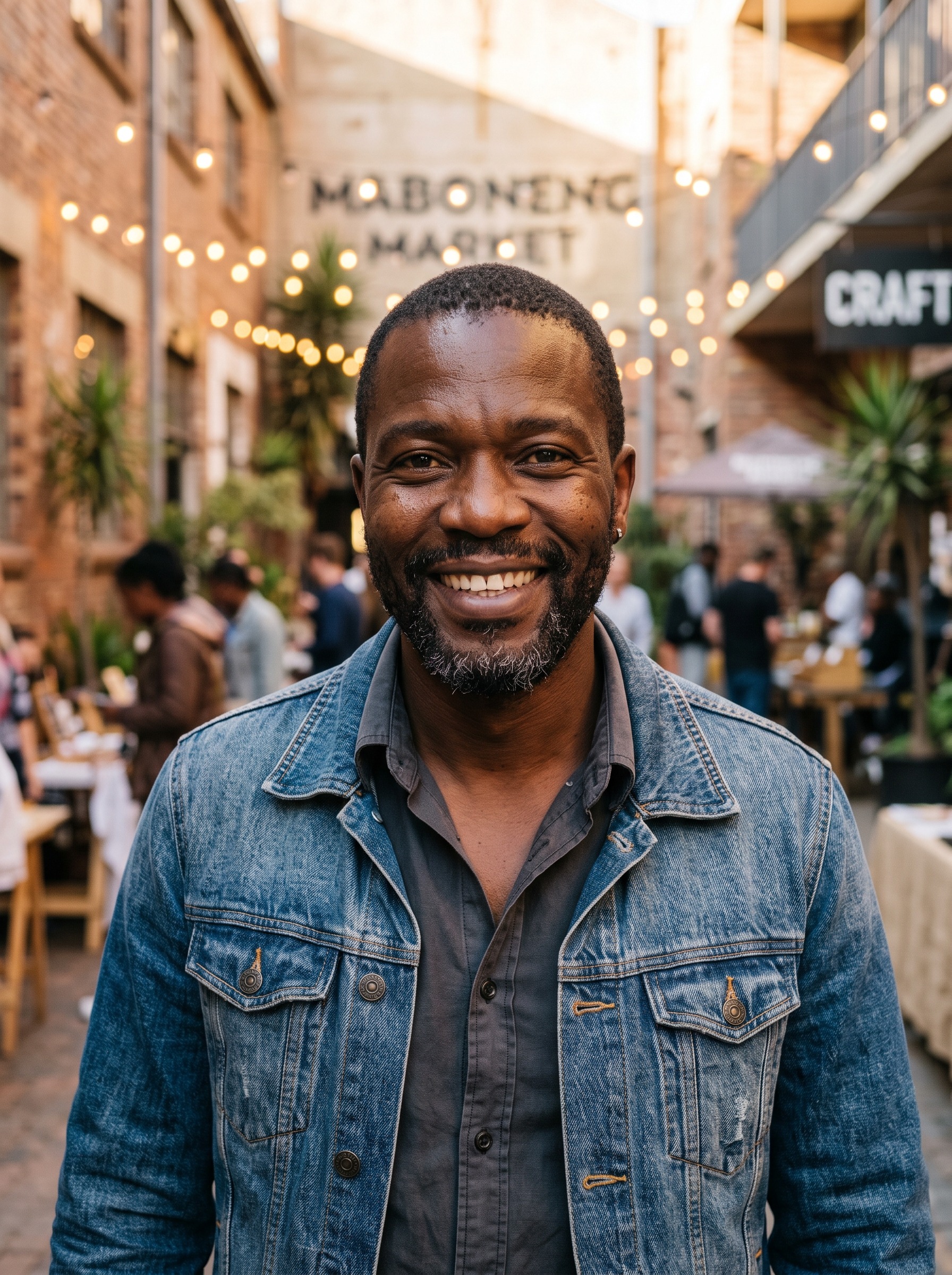
By Thabo MahlanguFollowing the shisa nyama smoke
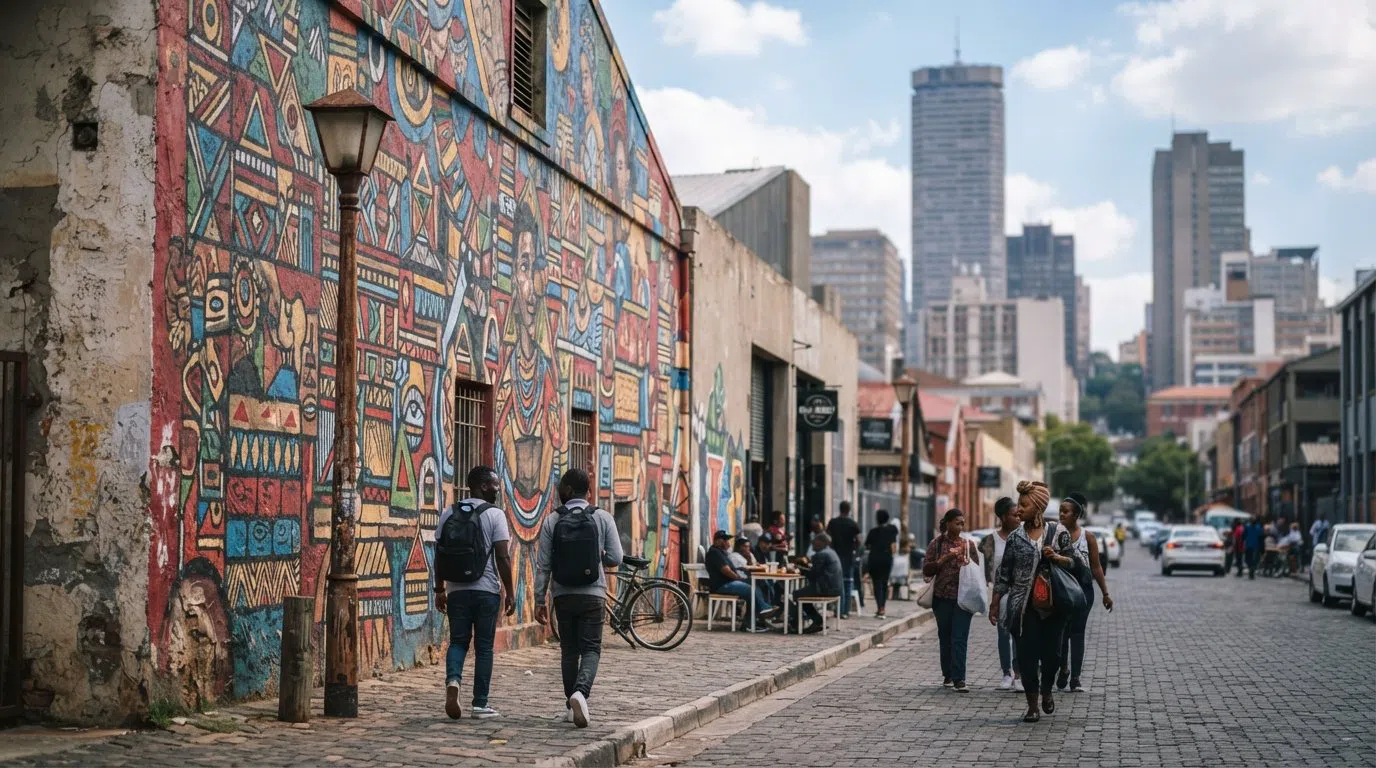
Maboneng means "place of light" in seSotho, and on a good day the name still earns its keep. Fox Street catches the sun off brick walls and painted plaster, a Sunday market spills sound and smoke into the courtyard, and the whole precinct feels like Johannesburg has decided, for a few blocks at least, to show you its working parts rather than its polished face.
What makes Maboneng interesting is not that it was ever neat. It was built from old clothing factories, warehouse shells and a lot of faith in the idea that people would come for art and stay for lunch. They did. Then the original developer went under, the headlines got gloomy, and the precinct had to survive the way real places do: by changing hands, shedding hype, and keeping the bits that actually worked. That is why it still feels alive. Not pristine. Alive.
What Maboneng is known for
Maboneng is the poster child for Johannesburg’s inner-city regeneration story, for better and worse. Property developer Jonathan Liebmann and Propertuity began buying derelict factory buildings along Fox Street around 2009, and the pioneer project, Arts on Main, opened in a century-old warehouse. The idea was simple enough: put galleries, studios, food and nightlife in walking distance of one another, then trust the city to meet it halfway.
For a while, the world came calling. Forbes put Maboneng among the coolest neighbourhoods in the world. Vogue called it Joburg’s coolest. That sort of praise can age badly if the district underneath it is all style and no staying power. Maboneng, to its credit, did not vanish when the applause softened. Propertuity was liquidated in October 2018, roughly ten buildings went through a 2019 fire sale, and plenty of people wrote the precinct off. But the culture stayed put. Tenants stayed. The murals stayed. The weekend crowd stayed.
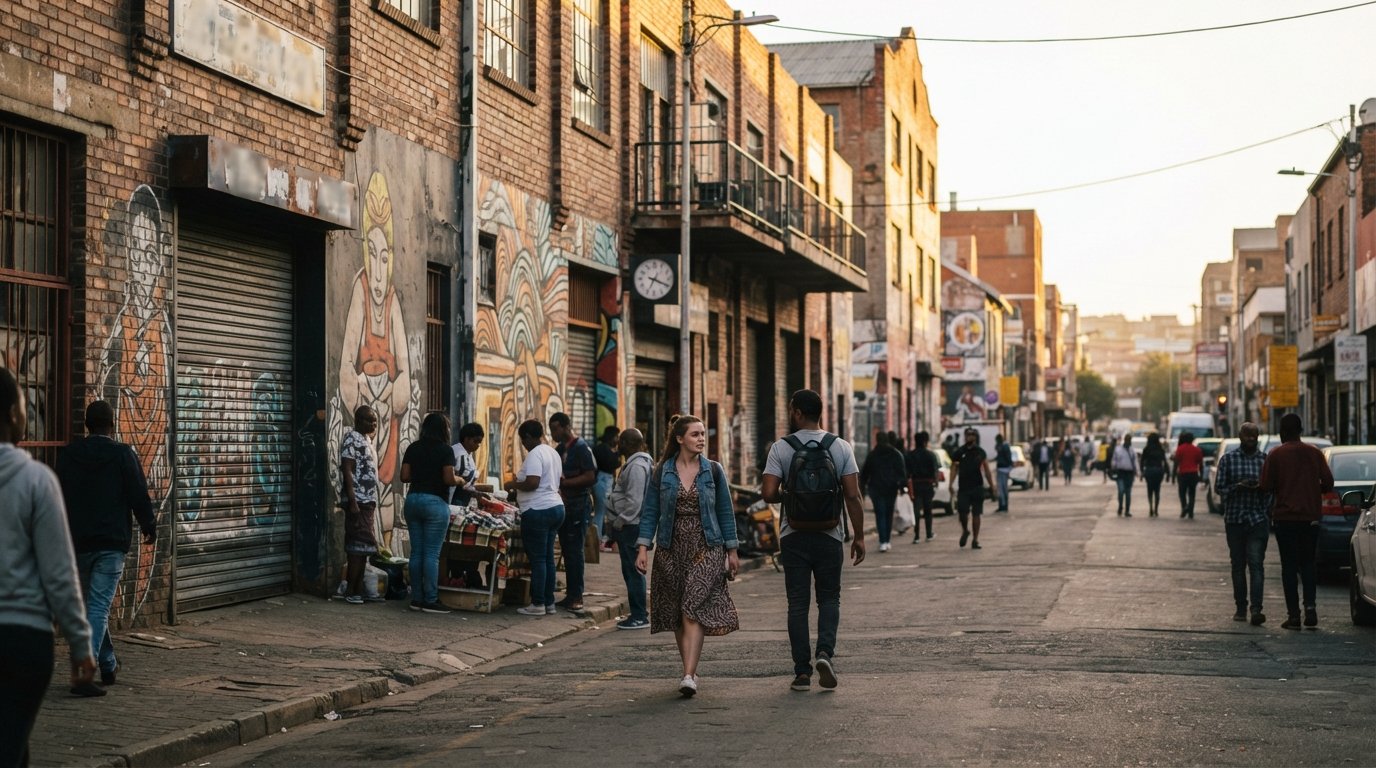
Then the next chapter arrived in concrete and capital. Divercity Urban Property Fund launched the R1.8-billion Jewel City redevelopment in 2020, adding three residential blocks — The Diamond, The Emerald and The Onyx — plus shops and an urban park on the eastern edge. That mattered more than the brochures. It extended Maboneng eastward and opened a safer pedestrian route along Fox Street toward the ABSA financial precinct. In other words, the precinct stopped being a clever island and became a little more of a neighbourhood.
The feel of the place now is less glossy than the peak-hype years, but more convincing. Exposed brick, roller-door shopfronts, murals climbing three storeys up plastered walls, and the odd quiet stretch where a gallery is half-open and a café is carrying the weekday load. On a Saturday afternoon, a DJ can push Afro-house across the courtyards. After dark, live jazz leaks out of Pata Pata. By Sunday, the whole precinct seems to lean toward the market.
Plan your Johannesburg trip
Live prices from our booking partners.
Free cancellation on many rooms. We may earn a commission when you book.
Where to eat & drink
The eating in Maboneng is concentrated on and around Fox Street and the Arts on Main courtyard, which is exactly how it should be in a precinct this compact. You do not come here to chase twenty different dining districts. You come, you park yourself, and you let the blocks do the work.
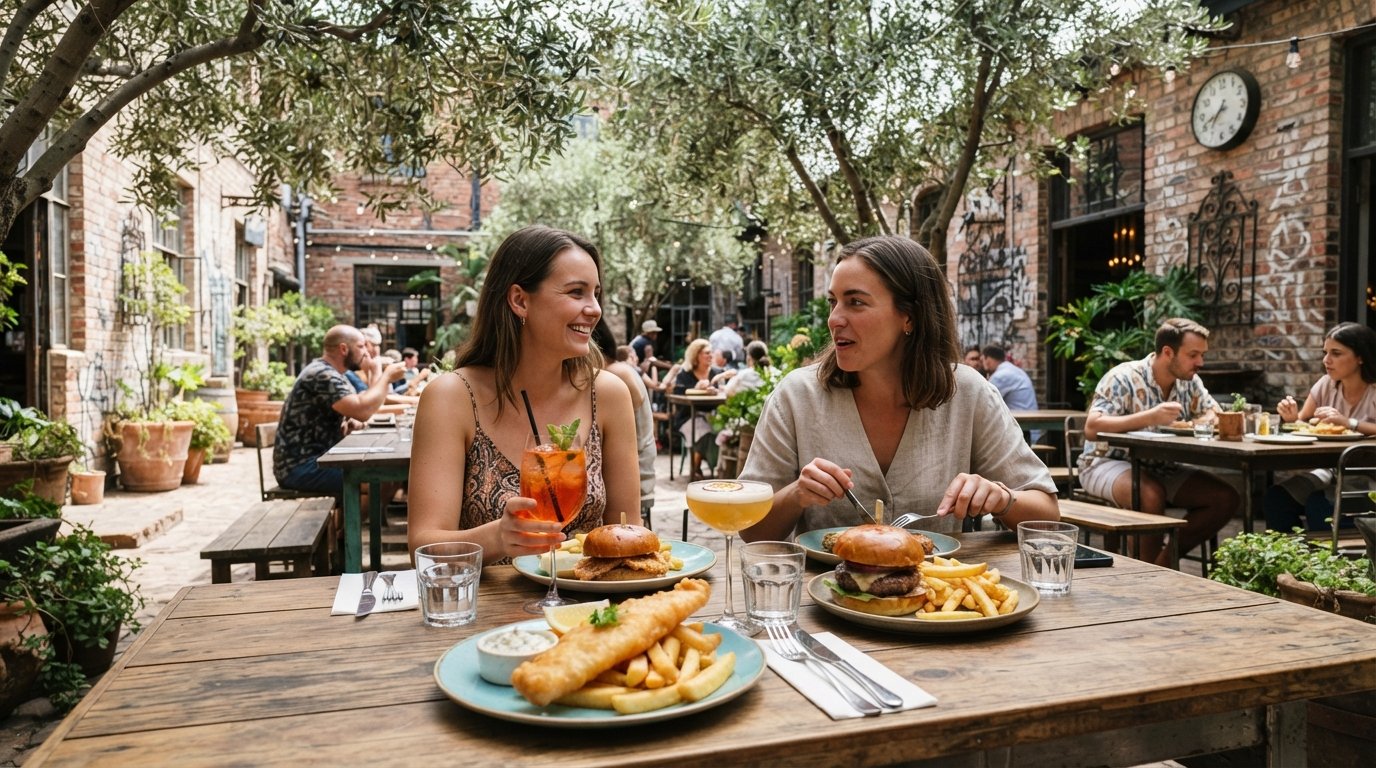
The most dependable table is The Canteen, tucked into the Arts on Main courtyard between the olive trees and the galleries. It is the precinct’s go-to bistro and cocktail bar, and also the place that quietly understands what people actually want in the middle of a day out: beer-battered fish, burgers, salads and a homemade chicken pie, with brunch doing the heavy lifting. Open Tuesday to Sunday in the day and Thursday to Saturday evenings, it is the sort of room that can absorb a gallery crowd, a market crowd and the occasional tired local all at once.
If you want something with a sharper angle, The Blackanese Sushi & Wine Bar in the Main Change building is the precinct’s most playful kitchen. Japanese technique, South African flavours, biltong and curry spice in the rolls — that is the sort of sentence that can sound like a gimmick until you taste it and realise someone actually thought about the balance. On Sundays, it runs a Mozambican-style seafood braai with spiced prawns and grilled fish, which is a fine way to remind yourself that Maboneng is not only about urban design and murals; it still understands appetite.
Mama Mexicana at 264 Fox Street has been slinging street-style tacos, flame-grilled fajitas and margaritas since 2013, which in Maboneng years makes it practically a landmark. No need to overcomplicate it. If the mood is tacos and a cold drink after a walk through the precinct, that is the move.
Eat Your Heart Out is the small kosher deli in the mix, and it speaks to the precinct’s habit of folding different food traditions into the same few blocks. Shakshuka, latkes and hot pastrami on rye, open Tuesday to Sunday until mid-afternoon. Daytime only, as a deli should be.
Then there is Pata Pata, the evening institution on Fox Street. African-and-global menu, wood-fired pizzas, cocktails and live jazz or a DJ working Afro-Cuban rhythms most nights. Reviews swing hot and cold, and that is worth saying plainly. Go for the room, the music and the after-dark atmosphere as much as the plate. In Maboneng, some places feed you and some places give you the night. Pata Pata tries to do both.
Going out
Maboneng’s nightlife is rooftop-and-event-led rather than a wall of clubs, and that is part of its charm. You are not here to bar-crawl a sprawl of anonymous streets. You are here to pick a perch, stay inside the precinct, and let the evening unfold around you.
The anchor is The Living Room, on the 5th floor of the Main Change building at 20 Kruger Street. It is exactly what it sounds like: a lush, plant-draped rooftop looking out over the downtown skyline, part eco-café, part sundowner bar, with tapas, signature cocktails and DJs on the weekend. It is cash-free, and the hours are weekend-weighted — early weekdays are usually reserved for private events, with the rooftop open to the public roughly Saturday from late morning to 10pm and Sunday until about 9:30pm. Check ahead if you are planning around it midweek; this is not a place that owes you a spontaneous opening.
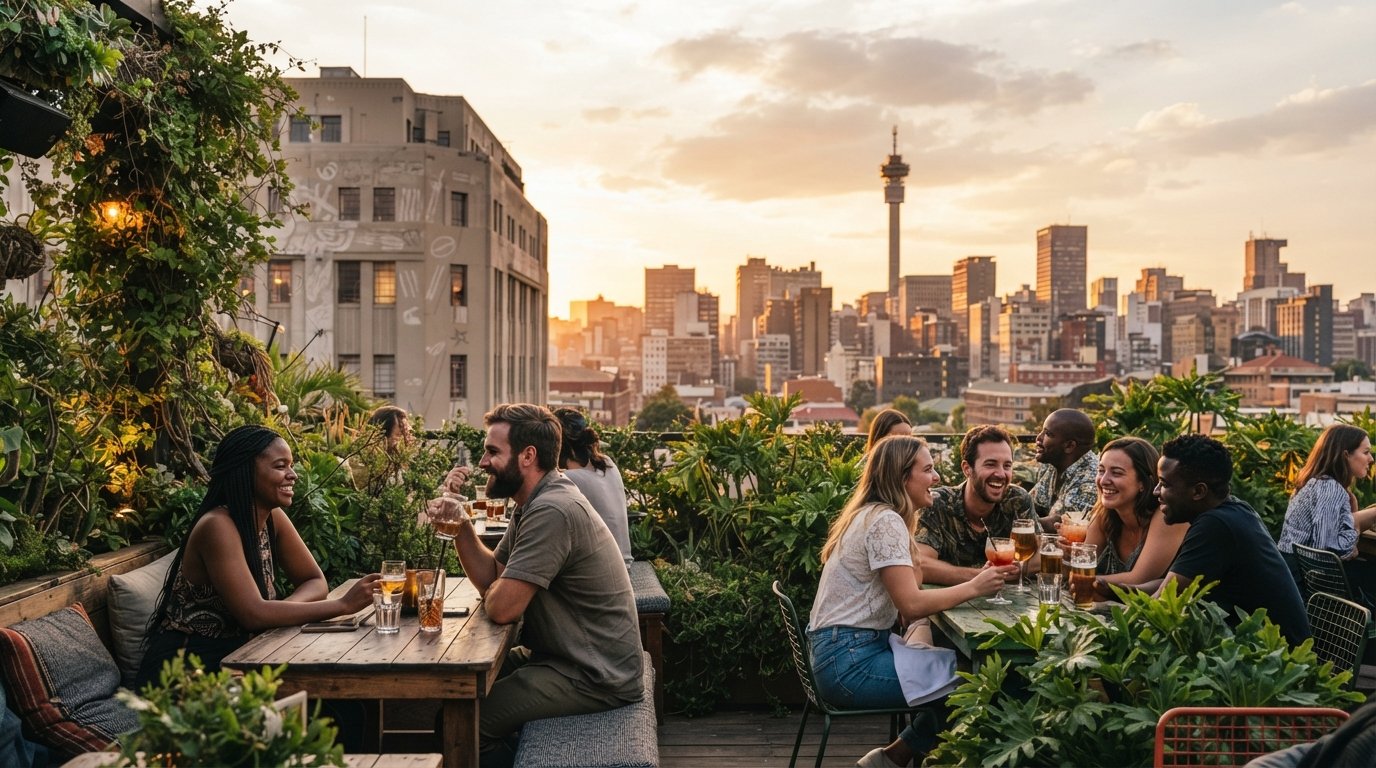
Pata Pata carries the live-music torch most evenings, and that is where the precinct’s social temperature often ends up. There is a difference between a place that plays music and a place that feels like music is part of the architecture. Pata Pata leans toward the second.
Market on Main also gets a night life of its own with the first-Thursday-of-the-month edition, running 7pm to 11pm except January and April. Food, craft stalls and live sets turn the Arts on Main courtyard into a looser, later version of Sunday. It is not a club night. It is better than that, if you like your evenings with something to look at and something to eat.
The honest read on Maboneng after dark: come for sundowners and live music inside the precinct, not for wandering around the surrounding streets. When you are done, call a car to the door. That is not drama; that is common sense.
Things to do / what to see
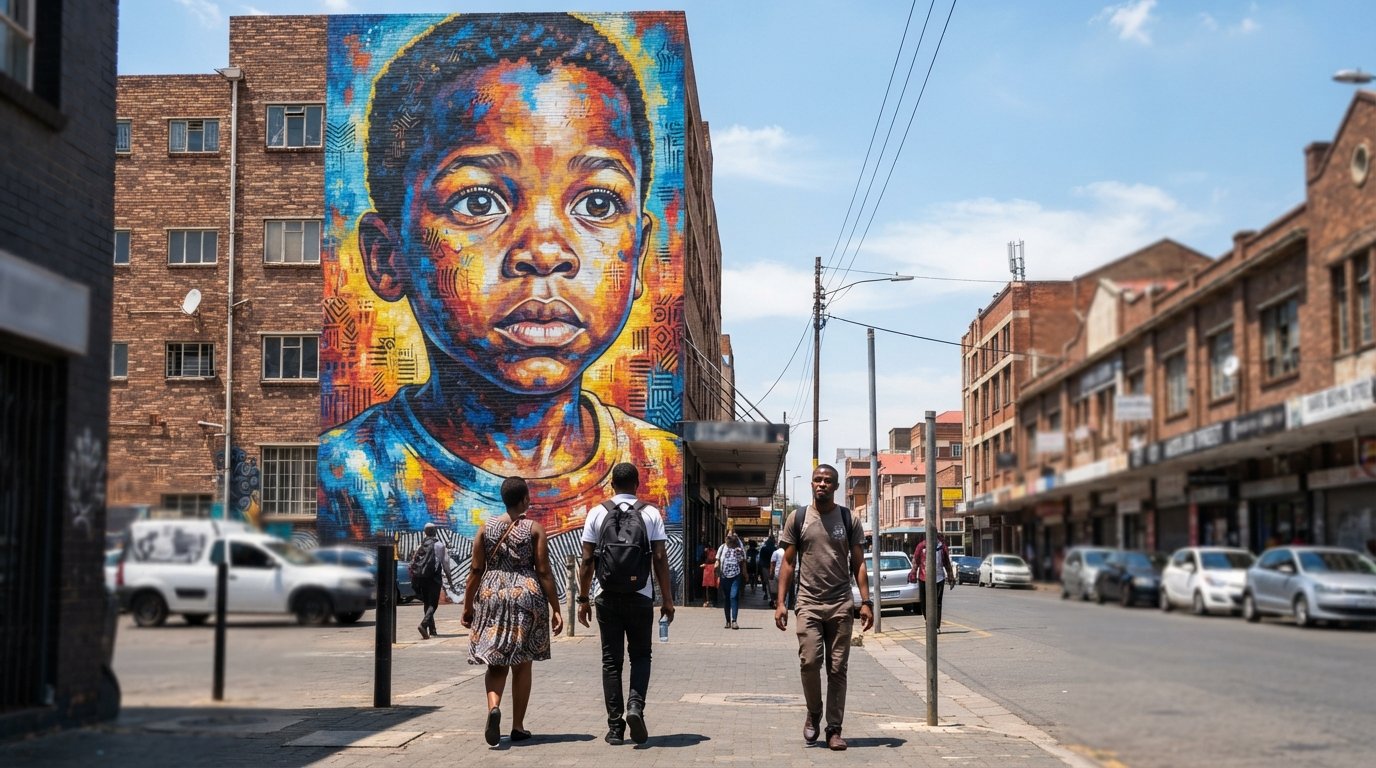
The single best thing to do here is walk and look up. Maboneng is an open-air gallery of large-scale murals, and the walls do not keep quiet. Nelson Makamo, whose bright portraits of children were championed by Oprah Winfrey, has work on Van Beek Street. Falko One, one of South Africa’s most respected graffiti artists, is dotted across the precinct’s walls. You can pass them quickly and say you saw street art. Or you can slow down and understand that these pieces are part of the precinct’s memory.
If you want the story behind the paint, a guided street-art or “evolution of Maboneng” walking tour is the smart move. Curiocity runs well-reviewed versions from its base on Fox Street, and the right guide can turn a wall into a timeline: the rise, the fall, the survival, the next layer. That is the difference between a neighbourhood that gets photographed and one that gets understood.
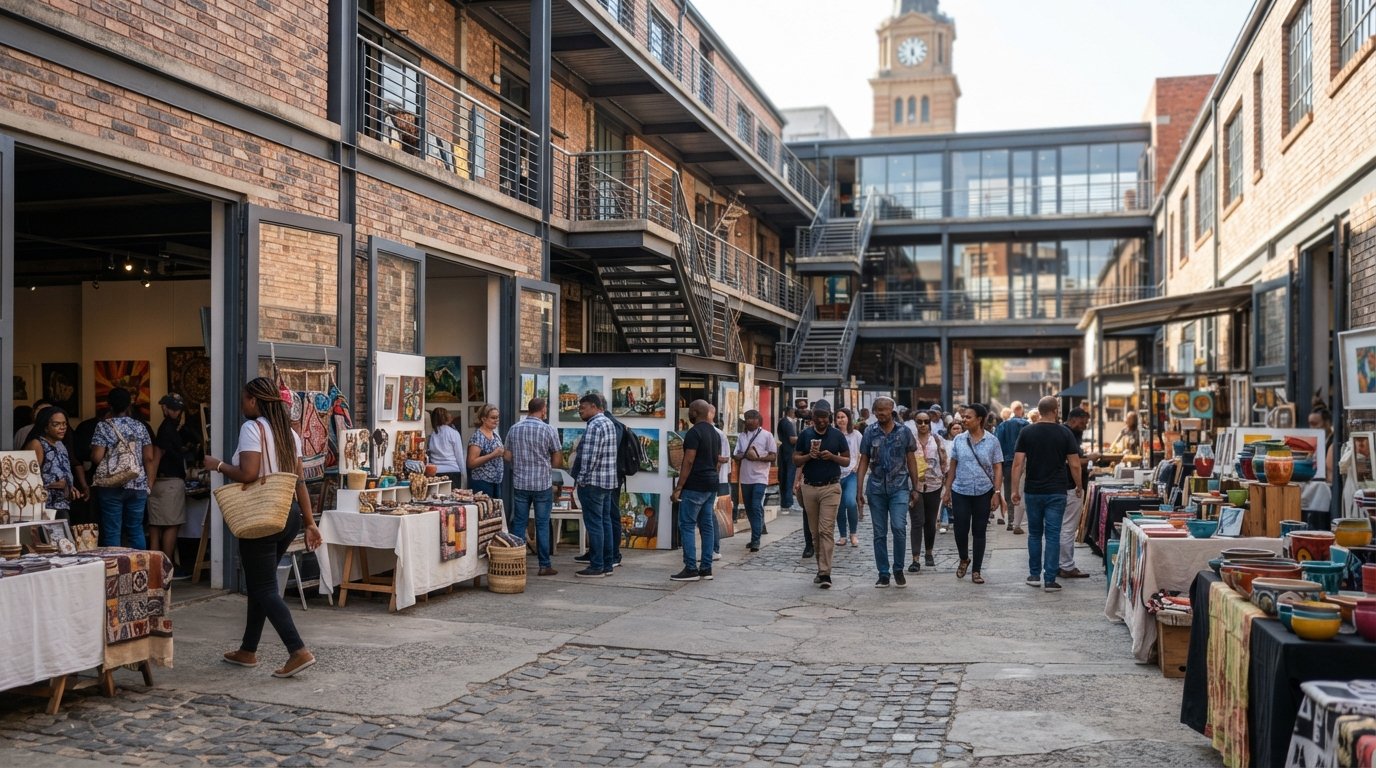
Arts on Main is the indoor anchor. It is the pioneer converted-warehouse hub for galleries, studios, shops and the Sunday market, and it still gives Maboneng its core rhythm. The Museum of African Design, or MOAD, occupies a warehouse space dedicated to contemporary African design. That alone tells you this is not a precinct built on nostalgia. It is interested in what African design looks like when it is alive, current and still arguing with the city around it.
If you can time your visit for a Sunday, do it. Market on Main runs in the Arts on Main courtyard from 10am to 3pm and is the precinct at its liveliest. Food stalls range from Ethiopian and Moroccan to Chinese and Italian, and the market folds in design, vintage and fashion vendors plus live music. It is the reason most people leave saying they wish they had come on a Sunday. They are right.
Don’t miss in Maboneng
Arts on Main for artist studios and weekend food stalls.
The Bioscope, an independent cinema showcasing African films.
Fox Street for street art tours and local fashion boutiques.
Shopping
Shopping in Maboneng works best as part of the wander. You are not coming here to tick off a polished retail parade. You come to browse, get distracted and perhaps find something better than what you planned to buy.
The concentration is again Arts on Main and the surrounding Fox Street buildings, where independent design studios, vintage and streetwear boutiques, and homeware and art stores sit among the galleries. These are the kind of owner-run places that come and go, which is another way of saying you should browse what is open rather than chase a specific label. That is the charm and the inconvenience of a creative precinct: it rewards curiosity more than certainty.
Market on Main on Sunday is the genuine shopping event. Beyond food, the stalls stretch into original prints, books, fashion, accessories, ceramics and plants. The first-Thursday night edition adds a craft-market slant. If you want a souvenir with some actual local texture, this is where you find it.
On the eastern edge, Jewel City leans practical rather than boutique, with everyday retail — a Shoprite, a Clicks pharmacy, a butchery-and-grill and fast-food outlets — serving the thousands of new residents. That is useful to know if you are staying over and need basics. Maboneng may have started as a design dream, but real neighbourhoods still need milk, medicine and a place to buy supper ingredients.
Where to stay in Maboneng
Staying in Maboneng is a deliberate, character-led choice rather than a convenience play. You do it because you want the precinct at your doorstep, not because you are trying to make life easy for a family of six with luggage and a tight schedule.
The signature stay is the 12 Decades Art Hotel in the Fox Street Studios building, where each room is themed around a decade of Johannesburg’s history and conceived by South African artists and designers. Quirky, design-forward and very on-brand for the precinct, it is the kind of hotel that remembers it lives in a neighbourhood with a point of view.
At the sociable, budget end, Curiocity Joburg is a design-led hostel on Fox Street set in a former printing works, with dorms and private rooms and a strong traveller community. It also doubles as the meeting point for the area’s walking tours, which makes the whole place feel plugged into the street rather than merely adjacent to it.
Beyond those, boutique lofts and short-let apartments come and go across the converted warehouses, and the newer Jewel City blocks add residential-style rentals on the eastern edge. Whichever you pick, the practical rules stay the same: arrive and depart by Uber, treat the precinct’s boundaries as your walkable zone, and lean on the daytime and event hours. {{HOTELS}}
Getting around
Maboneng sits in the eastern end of Johannesburg’s inner city, and the golden rule every sensible guide repeats is to arrive and leave by Uber or Bolt directly to the door rather than walking in from surrounding areas. That is not because the precinct itself is impossible to navigate. It is because the city around it is patchy, and the smart thing is to respect the boundary instead of testing it.
Inside the precinct’s few blocks, it is genuinely walkable. Fox Street is the spine, and everything from Arts on Main to the rooftop bars is a short stroll apart. During the day and evening there is visible private security on the corners, which helps the whole place feel more manageable than the map might suggest.
The nearest Gautrain station is Park Station in Braamfontein, the network’s southern terminus, which links fast to Sandton, Rosebank and directly to OR Tambo International Airport. From Park Station, take a car the last couple of kilometres into Maboneng rather than walking, because the route in between passes through rougher blocks.
Count on roughly 25–35 minutes by car to Sandton or Rosebank depending on traffic, and around 30–40 minutes to the airport. Do not drive yourself in unless you are comfortable with inner-city parking. Ride-hailing is cheap, plentiful and by far the least stressful way to do Maboneng.
If you want the plain truth, here it is: Maboneng is not a polished resort of a neighbourhood, and that is exactly why it still matters. It has scars. It has hype in its past. It has a few blocks where weekday energy can go flat and a Sunday that carries the whole show. But it also has murals that mean something, food that knows where it lives, and a regeneration story that did not end when the first developer did. For a visitor who wants Johannesburg with its sleeves rolled up, this is still one of the city’s most revealing walks.
Gallery
Maboneng in pictures
Maboneng — your questions
Is Maboneng safe to visit?
Yes, with normal downtown Johannesburg discipline. Maboneng is a privately secured, well-lit creative precinct that is safe to explore on foot during the day and evening, and it is busiest and best on a Sunday. The key rule is to arrive and leave by Uber or Bolt directly to the door and stay within the precinct’s few blocks rather than walking in from surrounding neighbourhoods.
Is Maboneng a good area to stay in Johannesburg?
It is a strong choice if you want character and creativity over convenience and polish. Design stays like the 12 Decades Art Hotel and Curiocity Joburg put you in the middle of the art, food and market scene. It is less ideal if you want a fully enclosed, effortless base or are a nervous first-timer, in which case Sandton or Rosebank are safer, more polished bets.
What’s the best day and time to visit Maboneng?
Sunday, without much competition. Market on Main runs in the Arts on Main courtyard from 10am to 3pm and is when the precinct is fullest, with food stalls, design vendors and live music. Weekdays can feel quiet outside the cafes, and The Living Room is often closed for private events early in the week. If you can’t do Sunday, aim for a Saturday or the first-Thursday night market.
What should I eat in Maboneng?
Start with brunch at The Canteen, then choose your mood: sushi with South African twists at The Blackanese Sushi & Wine Bar, tacos and margaritas at Mama Mexicana, shakshuka or pastrami at Eat Your Heart Out, and live-music dinner at Pata Pata.